


Shared Hosting vs VPS vs Cloud Hosting: Which One Is Right For Your Business?
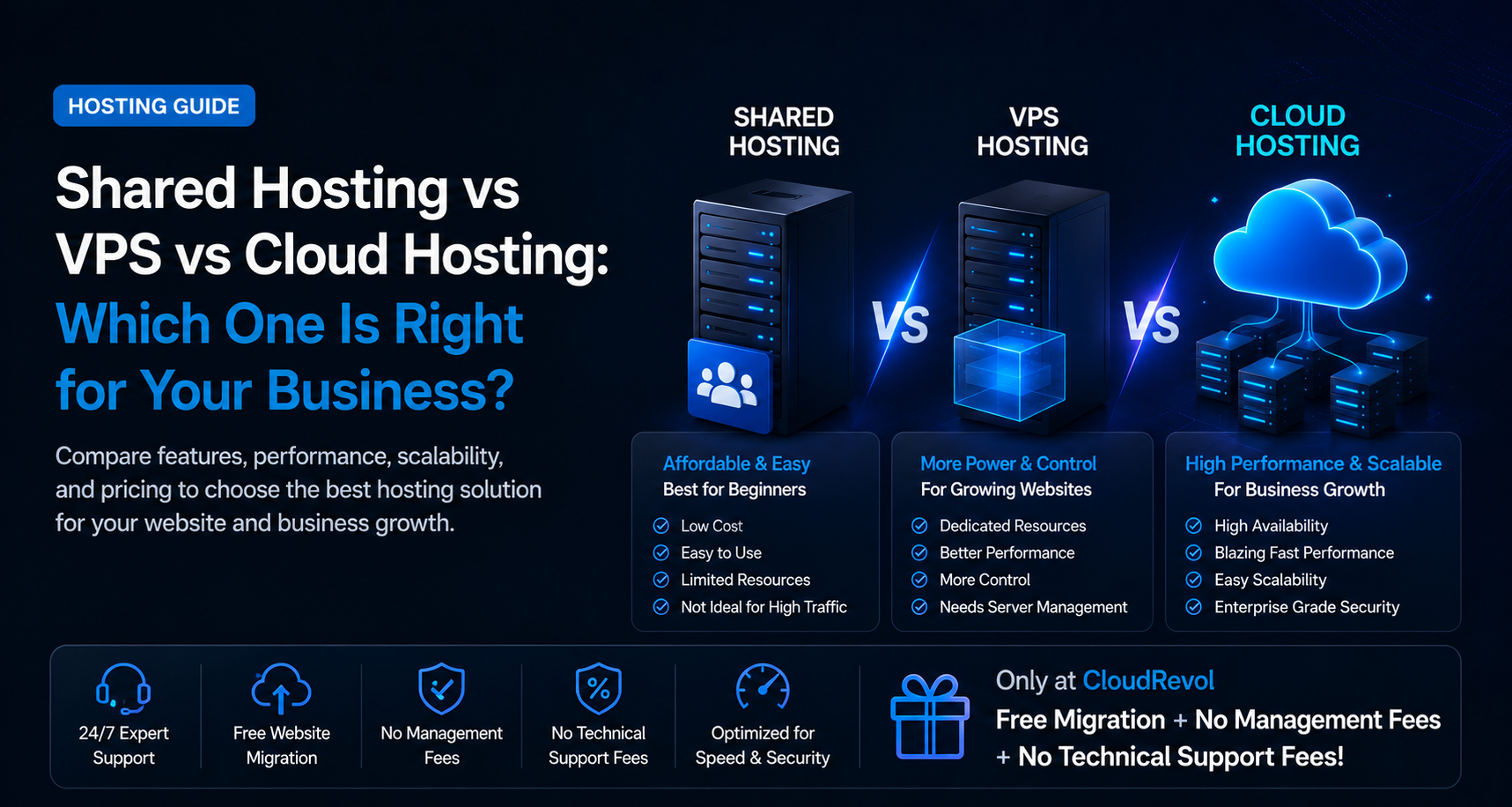
Not all hosting platforms are built the same. Choosing the wrong hosting solution can slow your website, increase downtime, and limit future growth. In this guide we'll compare Shared Hosting, VPS Hosting, and Cloud Hosting to help you make the right decision.
What Is Shared Hosting?
Shared Hosting places hundreds of websites on a single server. Every customer shares the same CPU, RAM, and storage resources.
Shared Hosting Limitations
- • Limited server resources
- • Slower website performance
- • Resource abuse from neighboring websites
- • Limited scalability
- • Basic security controls
What Is VPS Hosting?
VPS Hosting provides dedicated virtual resources on a server. Unlike shared hosting, your website receives allocated CPU, RAM, and storage.
VPS Advantages
- • Better performance
- • Dedicated resources
- • Improved security
- • More server control
However, many VPS providers charge additional fees for server management, monitoring, updates, security hardening, and technical support.
What Is Cloud Hosting?
Cloud Hosting uses multiple cloud resources working together to deliver higher reliability, scalability, and performance.
Cloud Hosting Benefits
- • High availability
- • Faster website performance
- • Easy scaling
- • Better uptime
- • Enterprise-grade security
- • Handles traffic spikes efficiently
Comparison Table
| Feature | Shared | VPS | Cloud |
|---|---|---|---|
| Performance | Low | Medium | High |
| Scalability | Limited | Moderate | Excellent |
| Security | Basic | Good | Excellent |
| Traffic Handling | Low | Good | Excellent |
Why Businesses Choose CloudRevol
Many hosting providers charge additional monthly fees for server management, monitoring, migration services, and technical support.
Why Businesses Choose CloudRevol
Businesses choose CloudRevol because we deliver enterprise-grade performance, security, reliability, and expert support without charging additional management fees. Our goal is simple: help your applications run faster, stay secure, and scale effortlessly.
AcceleronX Performance
Optimized hosting stack delivering faster page load times, improved responsiveness and better user experiences.
Free Migration
Move your websites, applications and databases without downtime or migration fees.
Expert Technical Support
Experienced engineers available to assist with hosting, performance, deployments and troubleshooting.
Security First
Firewalls, malware protection, security monitoring and proactive hardening help protect your infrastructure.
Automated Backups
Regular backups and recovery options ensure your data remains protected and recoverable.
No Management Fees
Receive technical assistance and platform support without hidden management charges.
Frequently Asked Questions
What is the difference between Shared Hosting and VPS Hosting?
Shared Hosting shares server resources among many customers, while VPS Hosting provides dedicated virtual resources for better performance, security and control.
What is the difference between VPS Hosting and Cloud Hosting?
VPS Hosting typically runs on a single physical server, while Cloud Hosting uses multiple infrastructure nodes, providing higher availability, scalability and redundancy.
Is Cloud Hosting better than Shared Hosting?
For most growing businesses, Cloud Hosting offers better performance, uptime, scalability and security compared to traditional Shared Hosting.
Which hosting type is best for WordPress?
Managed Cloud Hosting is often the best choice for WordPress because it supports caching, database optimization, backups, security monitoring and high traffic growth.
Which hosting is best for WooCommerce stores?
WooCommerce stores benefit greatly from Managed Cloud Hosting because of improved database performance, Redis caching, scalability and better uptime.
Which hosting is best for Laravel applications?
Laravel applications perform best on VPS or Cloud Hosting where PHP, queues, Redis and database services can be fully optimized.
Which hosting is best for Node.js applications?
Node.js applications generally require VPS or Cloud Hosting because they need process management, custom runtimes and scalable infrastructure.
Does hosting affect website SEO?
Yes. Faster hosting improves page load times, uptime, Core Web Vitals and overall user experience, which can positively impact search engine visibility.
Can I upgrade from Shared Hosting to Cloud Hosting later?
Yes. Most hosting providers offer migration services to move websites, databases and applications from Shared Hosting to Cloud Hosting with minimal downtime.
Is Managed Cloud Hosting worth the extra cost?
Managed Cloud Hosting often reduces operational overhead by including monitoring, security, backups, updates and expert support, making it cost effective for businesses.
What are the advantages of Cloud Hosting?
Cloud Hosting provides high availability, scalability, improved reliability, better performance and stronger disaster recovery capabilities.
Can Cloud Hosting handle traffic spikes?
Yes. Cloud Hosting platforms are designed to scale resources dynamically and maintain performance during periods of increased demand.
Final Verdict
Shared Hosting may be suitable for very small websites with minimal traffic. VPS Hosting provides more control and resources, but often requires technical expertise or additional management costs. Cloud Hosting offers the best combination of performance, scalability, reliability, and business continuity.
If you're looking for a managed hosting platform that delivers enterprise-grade performance without management fees, migration charges, or technical support costs, CloudRevol is built for you.