

MySQL vs PostgreSQL
Which Database Should You Choose in 2026?
A complete comparison of MySQL and PostgreSQL covering performance, scalability, reliability, security, cloud hosting and real-world business use cases.

Quick Answer
MySQL is often preferred for simplicity, WordPress hosting and traditional web applications.
PostgreSQL is generally preferred for modern SaaS, enterprise systems, analytics workloads and applications requiring advanced database features.
What Is MySQL?
MySQL is one of the most popular open-source relational database management systems.
It powers millions of websites including WordPress, WooCommerce and numerous business applications.
MySQL Strengths
- ✓ Easy To Learn
- ✓ Excellent WordPress Support
- ✓ Large Community
- ✓ Wide Hosting Support
- ✓ Proven Reliability
What Is PostgreSQL?
PostgreSQL is a powerful open-source object-relational database known for reliability, standards compliance and advanced capabilities.
It is widely used by SaaS platforms, financial systems, enterprise applications and cloud-native architectures.
PostgreSQL Strengths
- ✓ Advanced SQL Features
- ✓ Strong Data Integrity
- ✓ Excellent Scalability
- ✓ JSON Support
- ✓ Enterprise Ready
Core Architecture Comparison
MySQL
Optimized for speed, simplicity and traditional web applications.
PostgreSQL
Designed for advanced queries, complex data structures and enterprise workloads.
Performance Comparison
Performance depends heavily on workload type. MySQL often excels in simple read-heavy applications, while PostgreSQL performs exceptionally well with complex queries and large datasets.
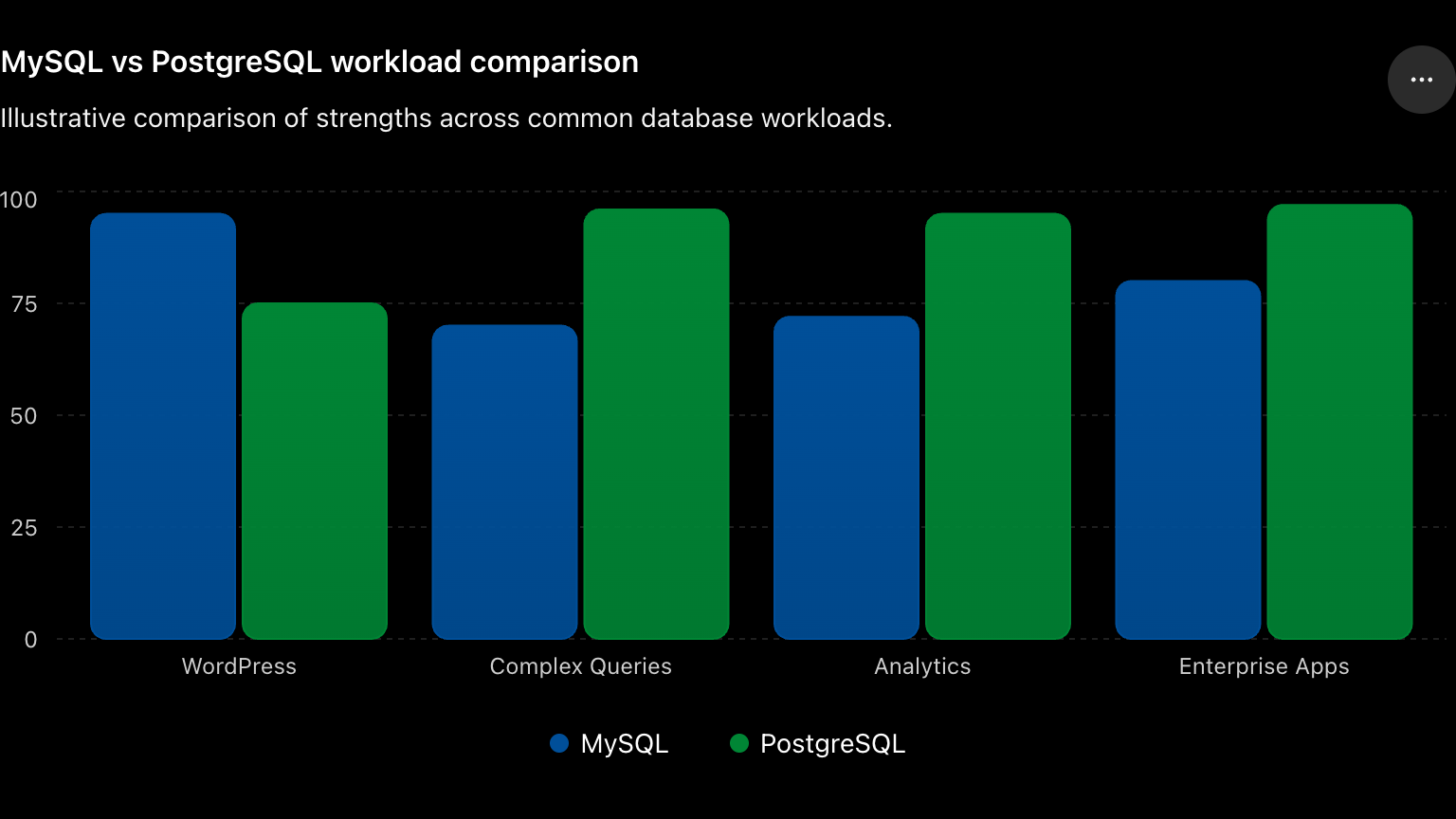
MySQL typically excels in WordPress and traditional web applications, while PostgreSQL is often preferred for analytics, enterprise systems, and complex database workloads.
Security Comparison
Both MySQL and PostgreSQL provide enterprise-grade security, but PostgreSQL is often recognized for its advanced security capabilities, standards compliance and granular access controls.
MySQL Security Features
- ✓ SSL/TLS Encryption
- ✓ User Privileges
- ✓ Role-Based Access
- ✓ Audit Logging
- ✓ Data Encryption
PostgreSQL Security Features
- ✓ Advanced Role Management
- ✓ Row Level Security
- ✓ SSL/TLS Encryption
- ✓ Extensive Auditing
- ✓ Enterprise Compliance Support
JSON Support Comparison
Modern applications increasingly rely on JSON data. Both databases support JSON, but PostgreSQL provides significantly more advanced capabilities.
| Feature | MySQL | PostgreSQL |
|---|---|---|
| JSON Storage | ✓ | ✓ |
| JSON Queries | Good | Excellent |
| JSON Indexing | Basic | Advanced |
| JSONB Support | ✗ | ✓ |
Scalability Comparison
Both databases scale effectively, but they excel in different scenarios.
MySQL Scaling
- ✓ Read Replicas
- ✓ Horizontal Scaling
- ✓ Large Hosting Ecosystem
- ✓ Excellent For WordPress
PostgreSQL Scaling
- ✓ Replication Support
- ✓ Partitioning
- ✓ High Availability Clustering
- ✓ Enterprise Scalability
MySQL vs PostgreSQL For SaaS Applications
Most modern SaaS platforms choose PostgreSQL because of its advanced query engine, JSON support and strong transactional consistency.
Typical SaaS Architecture
↓
Nginx
↓
Node.js
↓
PostgreSQL
MySQL vs PostgreSQL For WordPress
WordPress was built around MySQL and remains one of the most optimized environments for MySQL databases.
WordPress Recommendation
- ✓ WordPress → MySQL Recommended
- ✓ WooCommerce → MySQL Recommended
- ✓ Enterprise CMS → PostgreSQL Possible
- ✓ Custom Applications → PostgreSQL Preferred
Feature Comparison Matrix
| Feature | MySQL | PostgreSQL |
|---|---|---|
| WordPress | Excellent | Limited |
| Complex Queries | Good | Excellent |
| Analytics | Good | Excellent |
| JSON Support | Good | Excellent |
| Enterprise Workloads | Good | Excellent |
Which Database Should You Choose?
Choosing between MySQL and PostgreSQL depends on your application's requirements, expected growth, data complexity and long-term business goals.
Choose MySQL If:
- ✓ You run WordPress websites
- ✓ You manage WooCommerce stores
- ✓ Simplicity is important
- ✓ Your application uses standard SQL queries
- ✓ You need broad hosting compatibility
- ✓ You want easier administration
Choose PostgreSQL If:
- ✓ You build SaaS platforms
- ✓ You need advanced queries
- ✓ Analytics are important
- ✓ Data integrity is critical
- ✓ You use JSON heavily
- ✓ Enterprise scalability matters
Real World Use Cases
WordPress Hosting
MySQL remains the standard database powering the majority of WordPress websites worldwide.
WooCommerce Stores
MySQL performs exceptionally well when optimized correctly for e-commerce workloads.
SaaS Platforms
PostgreSQL is commonly selected for modern SaaS applications because of its flexibility and advanced database features.
Financial Systems
PostgreSQL is frequently chosen for financial, healthcare and enterprise applications where data consistency is critical.
CloudRevol Recommendation
At CloudRevol, we recommend selecting the database that best aligns with your application's requirements rather than simply following trends.
Our General Recommendation
MySQL
- ✓ WordPress Hosting
- ✓ WooCommerce Stores
- ✓ Shared Applications
- ✓ Traditional Websites
PostgreSQL
- ✓ SaaS Platforms
- ✓ Node.js Applications
- ✓ Analytics Platforms
- ✓ Enterprise Systems
Frequently Asked Questions
Is PostgreSQL better than MySQL?
Not necessarily. PostgreSQL offers more advanced features, while MySQL is often simpler and ideal for WordPress and traditional web applications.
Which database is faster?
MySQL can be faster for simple read-heavy workloads, while PostgreSQL often performs better for complex queries and analytics.
Which database is better for SaaS applications?
PostgreSQL is generally preferred for modern SaaS platforms because of its advanced capabilities and scalability.
Which database is better for WordPress?
MySQL is the standard database for WordPress and remains the recommended option for most WordPress sites.
Can I migrate from MySQL to PostgreSQL?
Yes. Database migration tools and professional services can help move applications between platforms with proper planning and testing.
Related Articles
Need Help Managing Your Database Infrastructure?
CloudRevol helps businesses deploy, optimize, secure and scale MySQL and PostgreSQL environments with managed cloud hosting, proactive monitoring and expert database support.